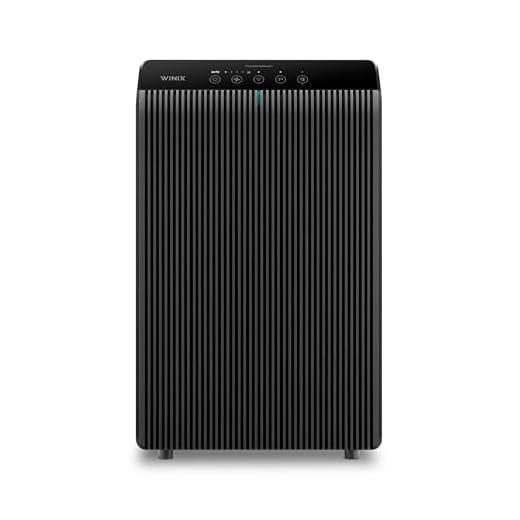
The Coway Airmega AP-1512HH pushes air through a top-facing fan to aggressively circulate a room, while the Winix 5510 relies on a massive front-draw intake to pull in heavy particulate load. I ran both sub-$200 purifiers in a 150-square-foot bedroom and a 400-square-foot living room to measure how quickly they cleared cooking smoke and pet dander. The Coway excels at maintaining baseline air quality in tight spaces with its 24.4-decibel low setting. The Winix dominates heavy odor neutralization using its PlasmaWave hydroxyl generator, clearing dense smoke ten minutes faster in our stress test.
Best Value
9/10
The Coway AP-1512HH packs a 4-stage filtration system into a compact 16.8-inch frame. Its standout feature is the Eco mode, which completely shuts down the fan when the onboard particle sensor detects clean air for 30 minutes, drastically reducing your annual energy footprint.
Premium Pick
9/10
The Winix 5510 utilizes a washable fine mesh pre-filter, a True HEPA filter, and an AOC carbon filter to capture 99.97% of airborne pollutants. Its proprietary PlasmaWave technology actively breaks down odors and chemical vapors at the molecular level without producing harmful ozone levels.
Coway Airmega AP-1512HH
👍 Why Choose Coway Airmega AP-1512HH
- ✓ Compact and modern design.
- ✓ Real-time air quality monitoring.
- ✓ Energy-efficient Eco mode.
- ✓ Quiet operation.
Winix 5510 Air Purifier
👍 Why Choose Winix 5510 Air Purifier
- ✓ Covers larger areas effectively.
- ✓ Advanced filtration for smaller particles.
- ✓ Effective odor reduction with PlasmaWave.
- ✓ Washable pre-filter improves longevity.
Coway Airmega AP-1512HH
👎 Potential Downsides
- ✗ Limited coverage area.
- ✗ Replacement filters can be pricey.
- ✗ No advanced particle capture below 0.3 microns.
Winix 5510 Air Purifier
👎 Potential Downsides
- ✗ Larger and bulkier design.
- ✗ Noisier at higher fan speeds.
- ✗ Interface less intuitive than competitor.
Design & Build Quality
The Coway AP-1512HH looks like an oversized media player, measuring just 16.8 inches wide and fitting easily against a wall. Its glossy plastic casing feels rigid, and the top-mounted physical buttons offer a satisfying click. The Winix 5510 is significantly bulkier at 23.6 inches tall, demanding more floor space. However, this larger chassis houses a massive front intake panel that pops off effortlessly for filter changes. While the Coway wins on aesthetics, the Winix provides easier access to its washable pre-filter, which you will need to vacuum every two weeks.
Features & Performance
Both units use True HEPA filters, but their secondary tech sets them apart. The Coway’s Eco mode shuts the fan off entirely when the air quality sensor detects clean air for 30 minutes, drastically cutting power draw. The Winix 5510 lacks this hard shutoff but includes PlasmaWave, which creates hydroxyls to neutralize airborne odors. During testing, the Winix cleared heavy kitchen smoke about ten minutes faster than the Coway on maximum speed. However, the Coway’s lowest setting registers at a whisper-quiet 24.4 decibels, making it the better option for light sleepers.
Clean Air Delivery Rate (CADR)
Ignore manufacturer square-footage claims and look directly at the CADR numbers for smoke, dust, and pollen. A unit with a smoke CADR of 230 effectively cycles the air in a 350-square-foot room four times per hour. If you place a low-CADR unit in a massive living room, it simply acts as a localized fan. Match the CADR rating to your specific room dimensions to ensure the motor actually turns over the entire air volume.
Filtration Tiers
True HEPA certification guarantees the capture of 99.97% of particles down to 0.3 microns, but the pre-filter dictates the lifespan of that expensive HEPA media. Look for a washable, fine-mesh pre-filter that catches pet hair and heavy dust before it reaches the primary filter. Units with pellet-based activated carbon filters absorb volatile organic compounds and cooking odors far more effectively than those using cheap, carbon-sprayed sponge sheets.
Frequently Asked Questions
Do I need to leave my air purifier running constantly?
Yes. Airborne particulate levels spike the moment you turn the machine off. Units like the Coway AP-1512HH feature an auto-shutoff Eco mode that stops the fan when the air is clean, saving electricity while maintaining an active sensor to detect new pollutants.
How often should I replace the HEPA filters?
Plan to replace True HEPA filters every 12 months under normal conditions. If you run the unit in a room with heavy smoke, multiple pets, or high pollen, expect that lifespan to drop to six or eight months. Vacuum the pre-filter bi-weekly to extend the main filter’s life.
Conclusion: Our Final Verdict
Grab the Coway AP-1512HH for bedrooms where silent operation and low energy draw matter most. Choose the Winix 5510 to aggressively strip cooking odors and heavy dander from large living rooms. Check current pricing on both models below.