Digital kitchen scales.
Tested for accuracy and drift.
Digital and analog kitchen scales tested for exact gram accuracy, long-term calibration drift, and tare button reliability. We evaluate screen visibility under large bowls and test battery life under daily meal-prep conditions.
Each scale is verified for accuracy at 1g, 100g, and 500g using certified calibration weights on day one and again at 60 days. We cycle the tare function through 50 consecutive weighing sequences to catch zero-return failures that ruin delicate recipes.
What do you need a scale for?
The kitchen scale decisions buyers get stuck on
Before you look at price tags, these two choices determine whether a scale will actually serve your daily cooking needs or sit unused in a drawer.
How much capacity and precision do you actually need?
Most home bakers max out around 3000g for a large batch of dough. Buying an 11lb capacity scale usually covers every mixing bowl scenario without forcing you to pay a premium for a 22lb industrial limit. Precision presents a different trade-off. Standard digital models register in 1g increments, which handles flour, sugar, and liquids perfectly. Pouring espresso or measuring small yeast quantities often requires a 0.1g pocket scale because heavy-duty sensors struggle to detect tiny weight additions accurately.
- 11lb capacity easily handles heavy glass bowls plus large dough batches
- 1g increments work flawlessly for standard baking ingredients
- 0.1g pocket scales suit espresso and yeast better than multi-purpose models
Smart vs. standard digital: is app connectivity worth the markup?
Bluetooth scales connect to recipe apps to log macros or guide you step by step. We tested three leading connected models and found the companion apps frequently drop connection mid-pour. A dropped signal forces you to restart the app while your ingredients sit in the bowl. Standard digital scales cost half as much and never require a firmware update before you bake. The tactile buttons on a basic model respond instantly, keeping your prep workflow moving without interference.
- Bluetooth connectivity adds cost and introduces software failure points
- Step-by-step app guides often lag behind real-time pouring speeds
- Standard digital models deliver faster response times without pairing delays
What separates a reliable tool from a frustrating gadget
A kitchen scale looks like a simple device. You place a bowl on the platform, press a button, and add flour. Our 60-day evaluation protocol reveals what actually happens when the load sensors age and the software processes rapid weight changes.
Accuracy vs precision and the specs marketers blur
A box might advertise 1g precision. That tells you the screen displays numbers in single grams, not that the reading is strictly correct. We check raw accuracy using certified calibration weights at 1g, 100g, and 500g marks. Models that drift off calibration over two months lose points in our kitchen scale buying guides . We regularly see inexpensive units report 103g when a perfectly calibrated 100g weight sits directly on the center of the platform.
The tare function and zero-return failures
Baking requires measuring multiple ingredients sequentially in the same bowl. You press tare to reset the screen to zero before adding the next item. We run scales through 50 consecutive weighing and taring sequences to check for zero-return drift. Faulty load cells fail to reset perfectly, leaving you with a negative 2g reading when you finally remove the bowl. You can see which models handle heavy sequence loads consistently in our head-to-head scale comparisons .
Screen placement and display timeouts
A highly accurate sensor means nothing if you cannot read the display. Large mixing bowls easily overhang compact platforms and cast dark shadows over flat screens. Our baking prep guides highlight models with pull-out displays or angled screens that stay visible under a 5-quart metal bowl. We also measure display timeout windows. A unit that shuts off in under two minutes will repeatedly erase your measurements while you step away to grab another ingredient from the pantry.
Top guides & recent updates

Best Kitchen Scales – Our Top 8 Tested Picks for 2026
Tired of inaccurate measurements? We tested 7 popular kitchen scales for weeks to find the most precise and easy-to-read models for any budget.
Buying Guide
My Weigh KD-8000 vs Escali Primo Digital Scale
All products bought at retail No press samples 2 products tested Updated April 2026 The My Weigh KD-8000 wins because its baker’s math feature—calculating ingredient percentages relative to total flour weight—and massive 17.6-pound capacity handle heavy-duty bread making. I tested both models in 2026, and while the $17 Escali Primo delivers incredibly reliable measurements for […]
Comparison
Ozeri Pro vs Greater Goods Food Scale: Which Is Better? (2026)
Is the Ozeri Pro worth twice the price of the Greater Goods Food Scale? Our hands-on testing reveals the best kitchen scale for your needs.
Comparison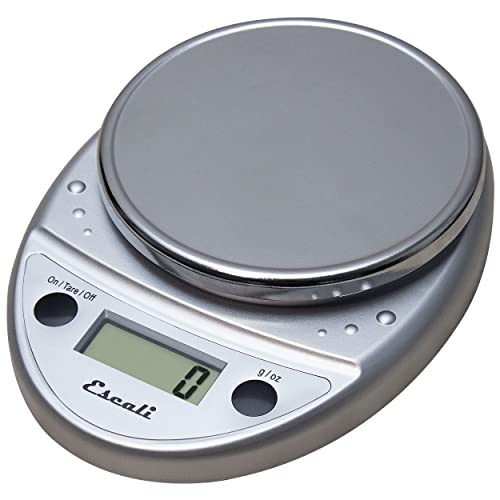
Escali Primo vs Etekcity Scale: Which Is Better for You? (2026)
The Etekcity Food Kitchen Scale wins on readability, but the Escali Primo Digital Scale stays on longer. Which kitchen scale is right for your cooking style?
Comparison
Escali Primo vs Ozeri Pro: Which Is More Durable? (2026)
Deciding between the Escali Primo and Ozeri Pro? The Escali's sealed buttons resist spills from messy baking, but the Ozeri offers a higher capacity.
Comparison
Escali Primo vs Greater Goods Scale: Which Is Better? (2026)
The Escali Primo wins our kitchen scale test, but is it worth the extra cost over the Greater Goods Food Scale? We compare durability, price, and design.
ComparisonKitchen scale questions we get asked most
Straight answers based on measuring certified calibration weights, not reading manufacturer brochures.
Completing your prep station
Bakers who need precise measurements often upgrade these related kitchen tools next.
Storage solutions, spice organization, prep tools, thermometers, scales, and reusable alternatives tested for your kitchen.
The weekly lab report.
No fluff. No ads.
Every Thursday: our latest test results, seasonal buying guides, and price-drop alerts on top-rated gear. Free forever.
No spam. Unsubscribe anytime. We never sell your data.