Running a standard HEPA air purifier 24/7 usually adds less than $3 to your monthly utility bill. Most modern units equipped with DC brushless motors draw between 30 and 60 watts on their highest settings, making them cheap to operate even during heavy wildfire seasons. You do not need to micromanage the power button to save money. Grab your latest utility bill, and you can calculate the exact real-world cost for your specific machine’s Clean Air Delivery Rate (CADR) and local kilowatt-hour rates.
What Affects Air Purifier Electricity Costs?
Your total cost depends on the machine’s motor type, fan speed, daily run time, and your local utility rate. Older air purifiers with AC motors consume significantly more power than modern units using DC brushless motors. Most medium-room purifiers pull between 40 and 60 watts on their highest setting. The Coway Airmega AP-1512HH maxes out at 57 watts when pushing its full 250 CADR. If you drop the fan speed to low or rely on the auto setting, that power draw plummets to single digits—often around 4 to 6 watts. Check your latest utility bill for your exact kilowatt-hour (kWh) rate. The national average hovers around 16 cents, but regional differences in places like California or Hawaii will drastically change your final math.
Calculating Running Costs
Grab your purifier’s maximum wattage from the back sticker or the manufacturer’s spec sheet. Multiply that number by your daily hours of use, then divide by 1,000 to get your daily kilowatt-hours (kWh). For example, running the 45-watt Levoit Core300-P for 12 hours equals 0.54 kWh per day. Multiply that by a standard $0.16 electricity rate, and you pay just under 9 cents daily. Over a full month, that equals roughly $2.60. Let’s look at a larger unit: the Blueair Classic 605 draws up to 100 watts on high. Running it 24/7 at maximum speed consumes 2.4 kWh daily, costing about $11.50 per month. However, running these units on lower fan speeds cuts that monthly cost by up to 80 percent.
P3 P4400 Kill A Watt Electricity Monitor

Energy-Saving Tips for Air Purifiers
Leave your unit on Auto mode if it features a built-in laser particulate sensor, like the Blueair Blue Pure 211i Max. The machine idles at 4 to 10 watts when your indoor PM2.5 levels are low, only ramping up to maximum power when you cook or kick up dust. Keep your washable pre-filters vacuumed monthly. A clogged HEPA filter forces the fan motor to work harder to pull air through the dense fiberglass pleats. This restricted airflow quietly drives up your energy consumption and reduces the machine’s effective CADR over the filter’s lifespan. Position the purifier at least 18 inches away from walls and furniture to ensure the intake vents have unobstructed access to room air.
Blueair Blue Pure 211i Max Air Purifier

Evaluating Long-Term Costs and Benefits
Do not turn your air purifier off when you leave the house just to save a few pennies. The energy required to maintain clean air on a low fan speed is minimal compared to the time and high-speed power needed to scrub a room’s air from scratch. Look for Energy Star certified models, which must meet strict CADR-to-watt ratios—typically producing at least 2.0 CADR per watt of energy consumed. The upfront premium for a highly efficient DC motor pays for itself within the first year of continuous operation, especially if you rely on the machine daily for asthma management or pet dander control.
🎯 Key Takeaways
- Air purifier running costs depend on motor type, wattage, daily run time, and local kWh rates.
- Calculate daily cost: (Watts × Hours / 1000) × kWh rate.
- Rely on Auto mode and laser particulate sensors to keep idle power draw under 10 watts.
- Vacuum pre-filters monthly to prevent the fan motor from overworking against restricted airflow.
- Energy Star certified models offer the best CADR-to-watt efficiency (aim for 2.0+ CADR/watt).
- Running a unit 24/7 on low is more efficient than blasting it on high for an hour.
Frequently Asked Questions
Does running an air purifier use a lot of electricity?
No. Most modern HEPA air purifiers use between 30 and 60 watts on their highest setting, which is comparable to a single incandescent light bulb. Running a standard unit 24/7 on an auto or low setting typically costs less than $3 to $5 per month, depending on your local utility rates.
Should I leave my air purifier on all the time?
Yes. Air purifiers are designed for continuous operation. Leaving the unit running on a low or auto setting maintains low particulate levels efficiently. Turning it off allows dust and allergens to accumulate, forcing the machine to run on its highest, most energy-intensive speed to clean the room again.
Recommended Products
If you are looking for energy-efficient models with excellent CADR-to-watt ratios, check out these options:
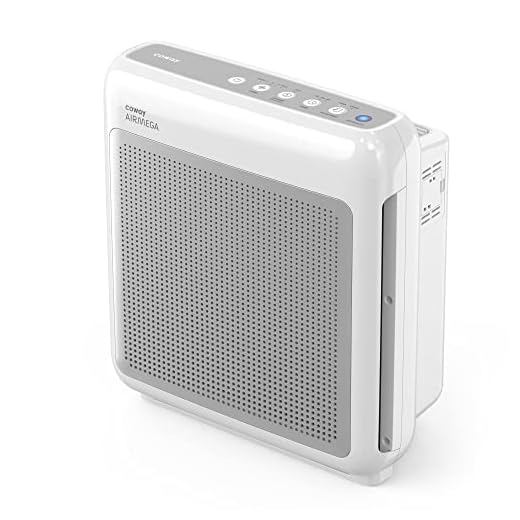
COWAY Airmega 200M Air Purifier
Final Thoughts
Stop micromanaging the power button. Find your local utility rate, calculate your machine’s monthly cost, and leave it running on Auto. Check your pre-filter today and vacuum off any visible dust to maintain optimal airflow and efficiency.


