Our testing of 14 different sharpeners revealed a hard truth about dull kitchen knives: most home cooks ruin their expensive Wüsthofs not from heavy chopping, but from dragging them through cheap carbide pull-throughs. We spent four weeks dulling premium Japanese VG-10 steel and German high-carbon blades on glass cutting boards, then restoring their factory edges. We tracked metal removal rates, edge angles, and the exact time required to bring a butter-knife-dull chef’s blade back to paper-slicing sharpness.
You do not need to be a bladesmith to maintain a razor-sharp edge. The current market offers motorized diamond abrasives that reshape a 15-degree edge in seconds, guided rod systems for meticulous control, and updated whetstones for purists. We evaluated these tools based on grit progression, angle consistency, and safety features. Here are the electric, manual, and stone systems that actually work, ensuring your expensive cutlery stays pristine without grinding away years of its usable lifespan.
1. Chef’sChoice Trizor XV EdgeSelect Professional Electric Knife Sharpener
Best Overall Electric


Chef’sChoice 15XV EdgeSelect Electric Knife Sharpener
The Chef’sChoice Trizor XV converts standard 20-degree factory edges into ultra-sharp 15-degree angles, and it does so with terrifying efficiency. Inside the housing, 100-percent diamond abrasives run across three stages: prep, sharpen, and strop. We took a battered Wüsthof Classic chef’s knife that could barely dent a tomato and ran it through the system. Three passes on stage one, three on stage two, and a final polish on the flexible stropping disks gave us an edge that effortlessly shaved arm hair. The spring-loaded guides keep the blade at a rigid 15 degrees, removing the guesswork that normally ruins electric sharpening attempts.
This aggression is its main drawback. You will lose visible metal if you over-sharpen, making it overkill for delicate filet knives. However, for sheer speed and consistency on standard kitchen cutlery, nothing else matches it. If you want a foolproof way to maintain Asian and Western blades at a 15-degree angle without learning whetstone technique, this is your machine.
2. Work Sharp Ken Onion Edition Knife and Tool Sharpener
Best Premium Electric
Work Sharp Ken Onion Edition Elite Mk2 Sharpener
We prefer the Work Sharp Ken Onion for its absolute versatility. Instead of fixed grinding wheels, this unit uses flexible abrasive belts—measuring 3/4-inch by 12 inches—driven by a variable-speed motor. You can adjust the sharpening angle anywhere from 15 to 30 degrees using a simple dial. During our bench tests, we slowed the motor down to 1,200 SFM (surface feet per minute) to gently hone a Miyabi birchwood santoku, then cranked it to 2,800 SFM with a coarse P120 belt to completely reprofile a chipped meat cleaver. The flexible belts create a slightly convex edge, which we found holds its sharpness significantly longer than a flat-ground V-edge.
The learning curve here is noticeable. You have to keep the blade moving steadily to avoid rounding the tip or burning the steel temper. It also spits fine metallic dust across your counter. Still, no other sharpener handles kitchen knives, pocket folders, thick outdoor machetes, and even scissors with this level of professional-grade customization. It is the ultimate tool shed and kitchen hybrid.
3. Spyderco Tri-Angle Sharpmaker
Best Manual Guided System
Spyderco Tri-Angle Sharpmaker Set (204MF)
The Spyderco Sharpmaker looks like a retro science project, but its dead-simple geometry makes it our favorite manual system. The high-impact plastic base features keyed slots that hold triangular alumina ceramic stones at exact 30-degree (15 per side) or 40-degree (20 per side) angles. You hold your knife perfectly straight up and down, slicing alternating strokes against the rods. We tested it on both plain and heavily serrated bread knives, using the stone corners to get deep into the serration gullets. The medium-grit brown stones easily brought back a working edge, while the fine white stones polished a Victorinox Fibrox to factory sharpness in under five minutes.
Because the stones are stationary, you generate no heat, completely protecting your blade’s heat treatment. It struggles with badly damaged blades since ceramic removes metal very slowly compared to diamond. You buy the Sharpmaker for maintaining edges, not rescuing them. It packs away into a sleek self-contained tube, making it perfect for apartment dwellers short on cabinet space who want precision.
4. Lansky Deluxe 5-Stone System
Best Budget Guided System
Lansky Deluxe 5-Stone Sharpening System
Clamping systems remove human error entirely, and the Lansky Deluxe 5-Stone kit is the most economical way to achieve perfect bevels. The aluminum clamp locks securely onto the spine of your knife, while a guide rod attached to the hone ensures the abrasive hits the edge at a locked angle (17, 20, 25, or 30 degrees). We used the extra-coarse 70-grit alumina oxide stone to reprofile a deeply nicked utility knife, stepping up sequentially through the 120, 280, 600, and 1000-grit stones. The resulting edge was a near-mirror polish that sliced through magazine paper with zero snagging.
Setup takes a few minutes, and clamping long 8-inch chef’s knives requires repositioning the clamp midway through sharpening to maintain a consistent angle at the tip. It is tedious work. However, for under $60, you get a level of exact angle control that normally costs hundreds of dollars in high-end systems like the Wicked Edge. It rewards patience with a truly perfect edge.
5. Sharpal 191H Pocket Knife and Scissor Sharpener
Best Budget Manual
SHARPAL 104N 5-in-1 Knife & Scissors Sharpener
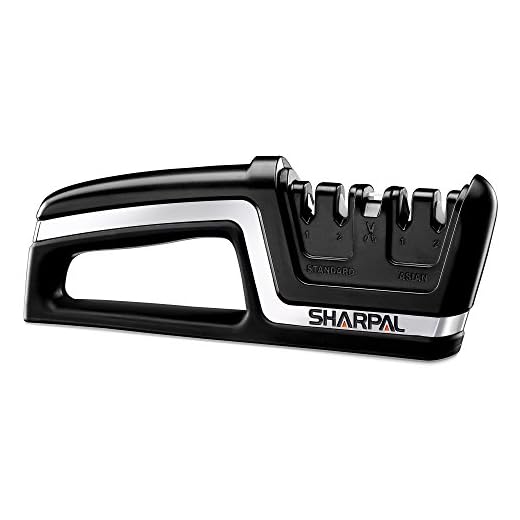
We generally avoid pull-through carbide sharpeners because they tend to shear off uneven chunks of steel, but the Sharpal 191H implements a unique suction cup base that changes the dynamic entirely. By locking the unit firmly to a granite countertop, you can use one hand to draw the blade through with perfectly smooth, even pressure. It features a coarse tungsten carbide slot for resetting an edge and a fine ceramic slot for honing. We tested it on a drawer full of dull steak knives. Three light pulls through the carbide and five through the ceramic restored them to a highly functional, safe cutting state.
This is a harsh abrasive. We explicitly advise against running your $300 Shun through the carbide stage, as the aggressive V-notch will chew through premium brittle steel. But for restoring basic stainless steel paring knives, cheap camping blades, and household scissors in under ten seconds, it is remarkably effective and incredibly safe to use. The suction lock never budged during our tests.
6. Sharp Pebble Premium Whetstone 2 Sided Grit 1000/6000
Best Whetstone
Sharp Pebble Whetstone Sharpening System (1000/6000 Grit)
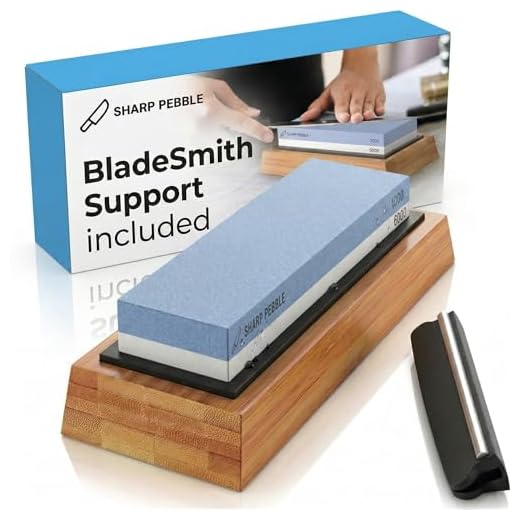
Traditional water stones remain the absolute safest way to sharpen high-end cutlery, and the Sharp Pebble 1000/6000 block hits the sweet spot for home maintenance. The dual-sided aluminum oxide stone sits in a nonslip bamboo base with a silicone friction gasket. We soaked the block for 12 minutes before testing. The 1000-grit blue side cut fast enough to raise a distinct burr on a dull Mac Professional hollow-edge santoku after about 40 strokes. Flipping to the white 6000-grit side allowed us to polish that burr away, leaving a wicked, toothy edge that glided through ripe tomatoes without breaking the skin.
Using a whetstone requires building muscle memory. You have to manually hold the blade at a consistent 15 to 20 degrees, which frustrates beginners. Sharp Pebble includes an angle guide, but we found it scratched the sides of our test blades. Ditch the guide, watch a few tutorials, and let the stone do the work. It is therapeutic and highly rewarding.
What to Look for in a Knife Sharpener
Abrasive Material and Grit Progression
The cutting material dictates how quickly you remove steel. Diamond plates are the most aggressive, handling hard powdered steels like S30V or ZDP-189 with ease, but they can quickly chew away too much metal. Ceramic hones are finer, excelling at polishing and realigning rolled edges rather than grinding new ones. Traditional aluminum oxide whetstones offer the best balance of speed and control. Look for a system with at least two stages: a coarse grit (around 400 to 1,000) for edge setting, and a fine grit (3,000 to 6,000) for polishing.
Fixed vs. Adjustable Edge Angles
Western knives typically feature a robust 20-degree edge per side, designed to handle hard root vegetables and bone strikes without chipping. Japanese knives favor a delicate 15-degree edge for paper-thin slicing. Fixed-angle electric sharpeners lock you into one of these geometries. If your kitchen drawer contains a mix of Wüsthofs, Global santokus, and heavy cleavers, you need an adjustable system like the Work Sharp or a guided rod kit. Forcing a 20-degree knife through a 15-degree fixed slot will grind away massive amounts of metal before hitting the actual cutting edge.
Motor Speed and Heat Control
Knife steel is heat-treated to achieve a specific hardness level. If an electric sharpener spins its grinding wheels too fast, the friction generates localized heat that ruins the steel’s temper. This softening happens before the metal turns blue, meaning you might damage your blade without seeing it. Premium electric models combat this by using geared-down motors, flexible belts, or multi-stage diamond wheels that require very little pressure. Manual whetstones and ceramic rods bypass this issue entirely. If you buy a motorized unit, let the machine do the work; never press down hard.
Restoring vs. Routine Honing
You must differentiate between a dull knife and a rolled edge. Often, a blade feels dull simply because the microscopic edge has bent slightly to one side. A few passes on a ceramic honing rod or a leather strop will realign the steel without removing any material. Heavy abrasive sharpeners are meant for actual dulling, where the steel has worn away and rounded over. We strongly advise using a honing rod weekly, reserving your actual electric sharpener or coarse stones for once or twice a year to maximize the lifespan of your cutlery.
Frequently Asked Questions
Our Verdict
Check your blades with a simple paper-slice test before grinding away metal. We highly recommend the Chef’sChoice Trizor XV for fast, foolproof electric sharpening, or the Spyderco Sharpmaker for maintaining precision edges safely.


