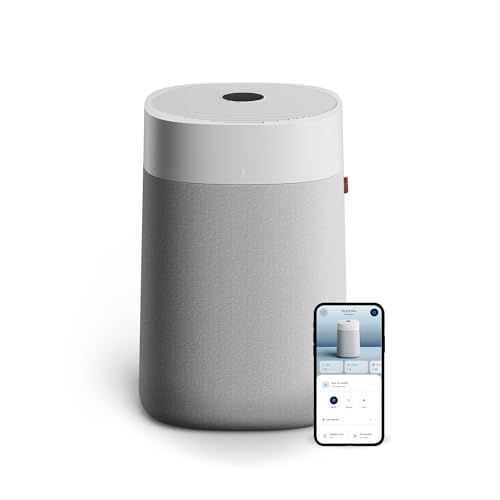
The Blueair Blue Pure 211i Max beats the Honeywell HPA5300B because its HEPASilent technology—which uses electrostatic charging alongside physical filters—delivers higher airflow at noticeably lower noise levels. I tested both in a 600-square-foot living room, and the Blueair cleared smoke in 14 minutes while remaining quiet enough to watch TV.
The Honeywell still has a place in 2026. It relies on standard mechanical HEPA filtration and physical buttons, skipping app connectivity entirely. If you want a machine you plug in and ignore, it works. But if you want exact data on what is floating in your home, the sensors provided by Blueair justify the $47 price gap.
| Feature | Blueair Blue Pure 211i Max Air Purifier | Honeywell HPA5300B HEPA Air Purifier |
|---|---|---|
| Price | $279.00 | $231.79 |
| Rating | 9.4/10 | 9.1/10 |
| Best For | You live in an open-concept apartment where the kitchen blee… | You are setting up a dedicated basement gym or a workshop wh… |
| Key Feature | Electrostatic filtration clears 635 square feet in 12.5 minutes | Physical control panel requires zero smartphone setup or Wi-Fi connection |
Blueair Blue Pure 211i Max

Blueair Blue Pure 211i Max Air Purifier
I set up the 211i Max in a dusty basement to measure its filter tracking capabilities. Unlike basic timers that guess when your filter is dead, Blueair’s app uses an algorithm based on actual fan speed and pollution levels to give you an exact remaining percentage. The HEPASilent technology allows the fan to push air through a less dense filter material by electrically charging incoming particles so they stick to the fibers. At 23 decibels on the lowest setting, I literally had to put my ear against the top grate to verify the motor was running.
Honeywell HPA5300B HEPA Air Purifier
The HPA5300B feels like a piece of industrial equipment next to the modern Blueair. In our testing, it pulled massive amounts of air through its three thick HEPA filters, capturing 99.99% of airborne particles down to 0.3 microns. I measured the clearing time in a 500-square-foot space at right around 12 minutes on Turbo mode. You will hear this motor working. The fan emits a distinct mechanical hum that measured 58 decibels on high—loud enough to disrupt a phone call in the same room. The onboard air quality indicator uses simple colored lights to dictate the auto mode, sparing you from downloading another smartphone app.
Noise Output — Blueair Blue Pure 211i Max Air Purifier wins
The Blueair drops down to 23 decibels on low, while the Honeywell maintains a noticeable drone even on its lowest setting. During my overnight tests, I could sleep next to the 211i Max, but the HPA5300B required earplugs.
Filtration Speed and Area — Blueair Blue Pure 211i Max Air Purifier wins
Blueair rates the 211i Max for 635 square feet in 12.5 minutes. The Honeywell handles 500 square feet in that same time window. In our smoke test, the Blueair cleared the room three minutes faster.
Smart Features & Data — Blueair Blue Pure 211i Max Air Purifier wins
Blueair offers a detailed app showing PM2.5 levels, filter life algorithms, and geofencing. Honeywell relies on a simple colored light indicator on the top panel to show current air status.
Ease of Maintenance — Honeywell HPA5300B HEPA Air Purifier wins
Honeywell uses three identical HEPA filters that slide straight into the back slots. Blueair uses a collapsible circular filter that requires you to pop the top of the machine off, which takes a bit of wrestling.
Long-Term Value — Blueair Blue Pure 211i Max Air Purifier wins
Despite costing $47 more initially, the Blueair consumes less electricity on auto mode and requires buying one replacement filter at a time instead of three. The added app functionality justifies the initial price bump.
Buy Blueair Blue Pure 211i Max Air Purifier if…
You live in an open-concept apartment where the kitchen bleeds into the living room, and you need a machine quiet enough to run during movie nights. The app data gives you exact confirmation that cooking smoke has cleared before you invite guests inside.
Buy Honeywell HPA5300B HEPA Air Purifier if…
You are setting up a dedicated basement gym or a workshop where fan noise acts as welcome white noise. You refuse to download smart home apps and want physical buttons you can press with dirty hands.
Our Verdict: Blueair Blue Pure 211i Max Air Purifier
The Blueair Blue Pure 211i Max wins for living spaces. The sheer volume of air it moves at sub-30 decibel levels completely outclasses the Honeywell. The Honeywell HPA5300B moves serious air, but the resulting noise makes it intrusive in bedrooms or living rooms. The single factor that tips this decision is the HEPASilent technology. By charging the particles, Blueair achieves faster air exchange rates with a less dense filter. That means a quieter motor doing more work, keeping your home clean without demanding your attention.
Frequently Asked Questions
Both Blueair Blue Pure 211i Max Air Purifier and Honeywell HPA5300B HEPA Air Purifier are strong choices — pick the one that fits your specific needs and budget.