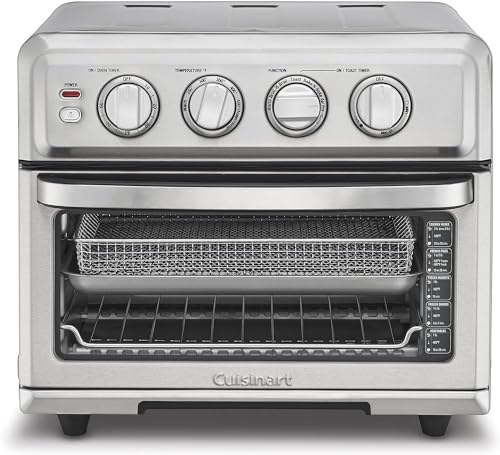
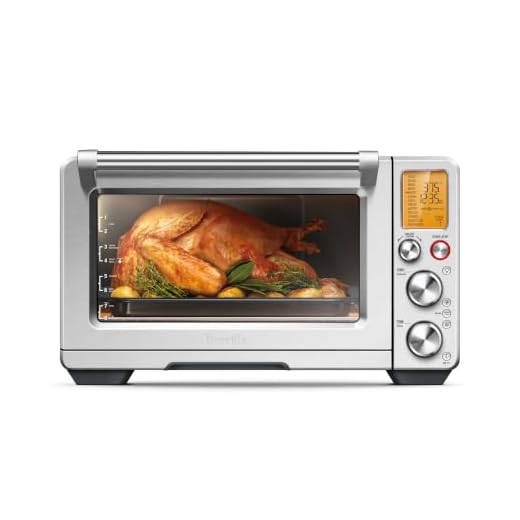
The Breville Smart Oven Air Fryer uses a PID controller and six quartz elements to hold baking temperatures within a strict 5-degree variance, while the Cuisinart TOA-70NAS relies on a high-RPM top-mounted fan and analog dials for aggressive, rapid crisping. After three weeks of testing both models with everything from frozen wings to 12-inch pizzas, the divide is clear. You are choosing between exact digital baking precision and raw, mechanical air-frying speed.
At $299.95, the Breville justifies its premium price tag with 13 distinct cooking functions and an incredibly accurate PID temperature control system. Buy this if you need a true secondary oven that handles delicate tasks like proofing dough just as well as roasting.
Priced around $159.95, the Cuisinart TOA-70NAS relies on a powerful convection fan and analog dials to deliver aggressive, fast air frying. Grab this model if you prioritize counter space and want frozen foods crisped in under ten minutes without navigating digital menus.
Breville Smart Oven Air Fryer
👍 Why Choose Breville Smart Oven Air Fryer
- ✓ 13 distinct cooking modes, including a dedicated dehydrate setting.
- ✓ PID temperature control holds heat within 5 degrees of your target.
- ✓ Super convection fan cuts roasting times by up to 30%.
- ✓ Heavy-duty brushed stainless steel housing and reinforced glass door.
Cuisinart TOA-70NAS Air Fryer
👍 Why Choose Cuisinart TOA-70NAS Air Fryer
- ✓ Consistently priced under $160.
- ✓ Four analog dials let you start cooking in three seconds.
- ✓ Aggressive top-mounted fan creates a heavy crust on fried foods.
- ✓ Includes a heavy-duty reversible grill and griddle plate.
Breville Smart Oven Air Fryer
👎 Potential Downsides
- ✗ Costs nearly twice as much as the Cuisinart.
- ✗ LCD menu requires scrolling through multiple screens to start cooking.
- ✗ 18.5-inch width eats up significant countertop real estate.
Cuisinart TOA-70NAS Air Fryer
👎 Potential Downsides
- ✗ Lacks low-temperature settings for proofing dough or dehydrating.
- ✗ Analog dials lack exact temperature markers.
- ✗ Mechanical timer ticks audibly and cannot be set to exact minutes.
Design & Build Quality
The Breville Smart Oven Air Fryer dominates the countertop with an 18.5-inch brushed stainless steel chassis and a heavy, reinforced glass door. The digital LCD screen and magnetic auto-eject rack feel engineered for exact adjustments. Cuisinart takes an analog approach. The TOA-70NAS uses four mechanical dials that let you start cooking in three seconds, though you lose the exact temperature markers found on the Breville. The Cuisinart’s lighter build lacks Breville’s vault-like feel, but its narrower footprint saves valuable workspace in cramped kitchens.
Features & Performance
Breville’s Element iQ system uses six independent quartz heating elements to hold temperatures within a tight 5-degree margin. During testing, it baked a 12-inch pizza with a perfectly even crust from edge to center. The Cuisinart TOA-70NAS, however, is an air-frying brute. Its top-mounted fan pushes aggressive heat that crisped a pound of frozen wings five minutes faster than the Breville. You trade Breville’s 13 precise functions—like proofing and dehydrating—for Cuisinart’s raw speed and a highly effective reversible grill plate.
Temperature Control Systems
Mechanical thermostats swing wildly, often overshooting your target temperature by up to 40 degrees before the heating elements cycle off. If you bake delicate items like cakes or proof bread dough, you need a unit with a Proportional-Integral-Derivative (PID) controller. PID systems pulse power to individual quartz elements, maintaining the cavity heat within a strict 5-degree variance. Analog dials work fine for blasting frozen fries at 400 degrees, but they fail when a recipe requires exact, sustained heat over a long duration.
Fan Placement and Airflow
Air frying relies entirely on convection speed. Look at where the manufacturer mounted the fan. Side-mounted fans create horizontal airflow that excels at even roasting across multiple racks. Top-mounted fans sit directly above the heating elements, blasting intense, concentrated heat straight down onto the food. This top-down approach mimics a commercial salamander broiler, cutting cooking times by up to 30 percent and creating a thicker crust on chicken wings. Choose top-mounted fans for speed, and side-mounted fans for baking consistency.
Frequently Asked Questions
Can you put aluminum foil in these air fryer ovens?
Yes, but keep it away from the heating elements and the convection fan. In the Breville, secure foil tightly to the crumb tray. Never cover the Cuisinart’s air fry basket with foil, as it blocks the top-down airflow required for crisping.
Do these ovens get hot on the outside?
Both models generate significant exterior heat. The Cuisinart’s top panel easily exceeds 140 degrees during a 400-degree air fry cycle. Leave at least four inches of clearance above and behind either unit to prevent cabinet damage.
Conclusion: Our Final Verdict
Buy the Breville if you need exact PID temperature control for baking and proofing dough. Grab the Cuisinart to blast frozen wings crispy in ten minutes. Measure your vertical cabinet clearance before adding either to your cart.

Related Comparisons
Check out our other head-to-head comparisons:
• Breville Smart Oven Air Fryer vs Ninja Foodi XL Pro DT201 – Which Should You Buy?