Spice storage systems.
Tested for capacity and access.
We test drawer inserts, tiered shelf racks, and rotating turntables to find systems that actually fit modern kitchen dimensions. Our evaluation separates theoretical capacity from usable space, so you buy the setup that matches your specific cabinet depth and jar collection.
Every rack and turntable is loaded with standardized 2oz and 4oz glass jar sets to verify the manufacturer’s capacity claims. We score label visibility under typical under-cabinet lighting and measure rotational stability on flat countertops and moving drawer floors to catch rattling or tip-prone designs.
Which spice storage problem are you solving?
The constraints that define a good spice setup
Buyers rarely need more spices; they need better access to the ones they have. These are the physical and spatial limits that dictate which storage type works.
Drawer insert, countertop, or wall mount: which setup fits your kitchen?
Choosing a storage format depends entirely on your available linear inches and daily cooking habits. Drawer inserts free up cabinet space and provide the best overhead view of your labels, but they require a drawer depth of at least 3.5 inches to accommodate standard 4oz jars. Tiered cabinet racks maximize vertical space but often obscure the labels on the back rows unless you use jars with top-printed lids.
Wall-mounted racks keep spices out of primary workspaces and in immediate reach near the stove. Turntables work best in corner cabinets where straight racks waste space, though they require a minimum 10-inch clearance diameter to turn freely. We test each format in real kitchen layouts to verify these dimensional limits before making a recommendation.
- Drawer inserts need 3.5-inch minimum depth for standard 4oz jars
- Tiered racks require top-labeled jars for full visibility
- Turntables demand at least a 10-inch turning radius in blind corners
Do standard 4oz jars actually fit tiered cabinet racks?
The biggest failure point in spice organization involves jar height. A manufacturer will advertise a rack that holds 24 jars, but that capacity only applies to half-size 2oz tins. When loaded with standard 4oz grocery store bottles, the rows overlap, the labels become unreadable, and the top row hits the cabinet ceiling. We load every tested rack with a standardized set of 4oz glass jars to measure the true working capacity.
We check the clearance gap between the top tier and standard adjustable shelf heights. If a rack requires you to tilt a jar aggressively to remove it from the back row, the system fails the usability test. Proper tiered racks provide at least 1.5 inches of visible label space per row and clear standard shelf heights with a loaded top tier.
- Advertised capacities frequently rely on undersized 2oz tins
- Top row clearance is measured against standard cabinet shelf spacing
- Racks must expose at least 1.5 inches of label on back rows
How much vertical space does a rotating turntable require?
A turntable seems like the perfect solution for a deep cabinet, but the rotation mechanics introduce a height penalty. The base bearing system raises the bottom platform by up to an inch. If the turntable is two-tiered, the center support column dictates exactly how tall the bottom-tier jars can be. In our testing, many two-tier turntables cannot fit standard 4oz bottles on the lower level, forcing buyers to place all tall items on the top tier, which then creates a tipping hazard when spun.
We measure rotational stability on flat countertops and moving surfaces. A quality turntable spins smoothly under an uneven load without wobbling, and features a rim high enough to prevent jars from sliding off the edge during a quick turn. Units that rattle or bind under the weight of 20 full jars are flagged in our reviews.
- Base bearings add height that can interfere with cabinet shelves
- Two-tier systems frequently fail to fit 4oz jars on the bottom level
- Smooth rotation under uneven weight loads separates good units from poor ones
What your cabinet measurements tell you before you buy
Marketing photos show identical matching jars with perfect lighting and unlimited shelf space. Real kitchens have mixed brand bottles, tight shelf clearances, and dark corners. Our evaluation strips away the staging to look at how these systems handle real-world geometry. The success of a spice organization setup depends entirely on aligning the physical constraints of your kitchen with the structural realities of the organizer.
Why advertised jar capacity rarely matches reality
A spice rack claiming it holds 30 jars is usually calculating that number based on narrow, 2oz containers. If you buy standard 4oz glass bottles or keep your spices in original grocery store packaging, that 30-jar rack might comfortably hold 18. We run a standardized jar fit test on every unit, filling it with identical 4oz square and round bottles to document the true capacity. Our spice rack buying guides rank units by their tested capacity, letting you know exactly how many standard jars will fit before you run out of space or find the sides overlapping.
The clearance gap that ruins drawer inserts
Drawer inserts are highly efficient, provided your drawer is deep enough to handle the tilt angle. Many slanted acrylic inserts push the front edge of a 4oz jar upward. If your drawer interior is exactly 3 inches high, the jar lip will catch the cabinet frame every time you pull the drawer open. We measure the exact vertical clearance required for every slanted insert when loaded with standard jars. In our drawer insert comparisons , we specify the minimum interior drawer depth needed to avoid scraping, preventing the most common post-purchase frustration in this category.
Rotational drag and turntable stability
The appeal of a turntable is fast access in a deep cabinet. That benefit vanishes if the base binds when loaded with heavy glass jars. We test turntables by loading one side with heavy salt and sugar containers and the other with light herbs, then measure the friction in the ball bearings. A well-designed turntable distributes uneven weight without dragging or tilting. We document which models glide smoothly and which ones require two hands to turn in our spice storage setup guides , while also noting which rim heights actually keep tall bottles from tipping over during rotation.
Top guides & recent updates
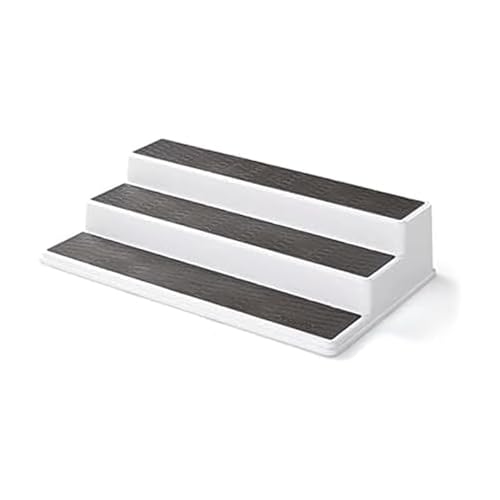
Copco vs Deco Brothers Spice Rack: Which Is Better in 2026?
All products bought at retail No press samples 2 products tested Updated March 2026 The Copco 3-Tier organizer is your pick for a standard, fixed-width cabinet on a serious budget. It’s a simple, set-it-and-forget-it solution. You buy it for a specific space where its 15-inch width fits perfectly, and you don’t plan on changing your […]
Comparison
Simple Houseware vs Deco Brothers Spice Rack: Which Is Better?
All products bought at retail No press samples 2 products tested Updated March 2026 Your choice between these two spice racks comes down to one thing: are you organizing on a countertop or inside a cabinet? The Simple Houseware rack is a freestanding unit meant to live on your counter. It gives you quick access […]
Comparison
How to Store Spices Long Term
Heat and light will destroy your expensive spice collection in weeks. You can extend the life of your seasonings by years when you ditch the flimsy plastic grocery store bottles for airtight glass or metal containers stored in a dark pantry. This simple swap protects the volatile oils that give spices their distinct flavor profiles. […]
How-To
Kamenstein Spice Rack vs Petite Cuisine Tuna: For Chef or Cat? (2026)
We compare the Kamenstein Spice Rack and Petite Cuisine Tuna to see which household item offers more value. Is it the kitchen organizer or the cat food?
Comparison
How to Label Spice Jars: A Step-by-Step Guide
A chaotic spice cabinet actively ruins your cooking timing. You waste precious minutes hunting for cumin while your garlic burns in the pan. Labeling your spice jars solves this problem instantly. You can find exactly what you need at a glance. The process requires a small upfront time investment, but the daily payoff is massive. […]
How-ToCommon questions about organizing spices
Tested answers on capacity limits, jar formatting, and storage locations.
More kitchen organization and prep gear
A structured kitchen relies on more than just a tidy spice drawer.
The weekly lab report.
No fluff. No ads.
Every Thursday: our latest test results, seasonal buying guides, and price-drop alerts on top-rated gear. Free forever.
No spam. Unsubscribe anytime. We never sell your data.