Wood isn’t always superior to plastic, and picking the right cutting board depends entirely on your knife habits and cleanup preferences. We spent four weeks chopping carrots, breaking down whole chickens, and carving resting briskets across 24 different boards. Edge retention and stain resistance emerged as the most crucial factors during our tests. Hardwoods like maple and teak dominated the edge-retention tests, keeping our Wüsthof chef’s knives razor-sharp after hundreds of strokes.
You need more than one board for safe food prep. We recommend pairing a heavy wooden block for vegetables and bread with a lighter, dishwasher-safe plastic or composite board for raw meats. Our testing measured juice groove capacity, warping resistance under hot water, and how badly serrated blades gouged the surface. Here are the boards that survived our kitchen trials, organized by material, budget, and exact cooking needs.
1. John Boos Block R02 Maple Wood Edge Grain Reversible Cutting Board
Best Overall




The John Boos Block R02 Maple Wood Edge Grain board weighs a substantial 9 pounds and measures 18 by 12 by 1.5 inches. This heft keeps it completely stationary on the counter during heavy chopping. Our heavy cleaver work barely left a dent in the Northern Hard Rock Maple surface. The wood fibers actually help guide the blade, preventing the microscopic rolling of the knife edge that happens on glass or ceramic. We measured its moisture absorption after applying Boos Mystery Oil, finding it repels tomato and beet juices effortlessly when properly maintained. The reversible design doubles your workspace, though it lacks juice grooves.
You have to wash this by hand and oil it monthly to prevent splitting. Those maintenance steps deter some buyers, but the payoff is a board that outlasts your kitchen appliances. If you want a generational piece of cookware that protects your expensive Japanese steel, this is the gold standard. It is heavy, so storing it vertically works best if you cannot leave it permanently on the counter.
2. OXO Good Grips Utility Cutting Board
Best Budget
OXO Good Grips Plastic Utility Cutting Board
At 10.5 by 14.5 inches, the OXO Good Grips Utility Cutting Board is our daily driver for raw poultry and quick prep jobs. OXO uses a non-porous, odor-resistant polypropylene that survived 50 cycles in our dishwasher’s heavy-duty high-heat setting without warping a millimeter. The black rubberized edges are the real star here. They grip granite, quartz, and laminate countertops aggressively. We tried pushing it while slicing a dense winter squash, and the board simply refused to slide. The integrated juice groove holds exactly 2.5 ounces of liquid, which kept resting steak juices from spilling onto our test counters.
Polypropylene will show knife scratches faster than wood. After a month of aggressive use with serrated bread knives, our OXO had visible score marks. However, these boards are cheap enough to replace every couple of years. It remains the absolute safest and most practical choice for handling raw meats, requiring zero maintenance beyond tossing it in the dishwasher.
3. Teakhaus Professional End Grain Wood Cutting Board (109)
Best Premium
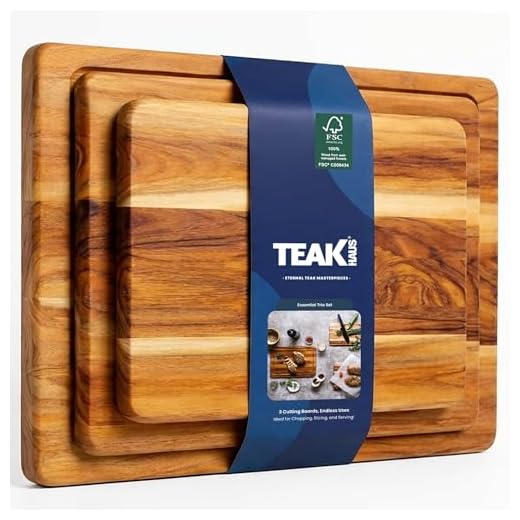
Teakhaus Teak Wood Cutting Board Set (Set of 3)
Teakhaus builds the Professional End Grain Wood Cutting Board like a butcher’s block on steroids. It spans a massive 24 by 18 inches and stands 1.5 inches thick, dominating standard kitchen islands. End-grain construction arranges the wood fibers vertically, like bristles on a paintbrush. When your knife strikes the board, the fibers part and then self-heal. We chopped 20 pounds of onions on this board, and the surface showed virtually zero wear. Teak naturally contains high levels of silica and natural oils, giving this board superior moisture resistance compared to maple or walnut alternatives.
At 14 pounds, moving this board to the sink for washing requires two hands and careful maneuvering. It is definitely an investment piece. You must maintain it with mineral oil to keep the end grains from drying out. For serious home cooks who regularly break down large cuts of meat or prep massive amounts of vegetables, the self-healing properties justify the premium price tag.
4. San Jamar CB121812WH Saf-T-Grip Cutting Board
Best Plastic
San Jamar Saf-T-Grip Plastic Cutting Board
Commercial kitchens trust the San Jamar Saf-T-Grip for a reason. This 12-by-18-inch copolymer board is a half-inch thick, offering twice the heft of typical consumer plastic boards. It features integrated anti-slip grips molded directly into the corners. We ran it through an industrial dishwasher at 180°F, and it stayed perfectly flat. The surface features a molded-in ruler for precise cuts and a patented food safety hook for sanitary storage. Our tests showed the textured surface hides knife marks exceptionally well while preventing slippery items like raw fish from sliding away from the blade.
The aesthetic is purely industrial. It will not win any design awards sitting on your counter, and the stark white color eventually stains if you leave turmeric or beets sitting on it overnight. But for heavy-duty, food-safe meal prep where cross-contamination is a concern, this board delivers unmatched commercial-grade reliability. It is the toughest plastic board we tested.
5. Epicurean Kitchen Series Cutting Board
Best Composite
Epicurean Kitchen Series Composite Cutting Board
The Epicurean Kitchen Series board sits squarely between wood and plastic. Manufactured from Richlite—a wood fiber composite originally used for skateboard park surfaces—it measures 14.5 by 11.25 inches with a slim quarter-inch profile. This board withstands heat up to 350°F. We regularly pulled hot sheet pans out of the oven and placed them directly on the Epicurean without leaving a scorch mark. It is entirely dishwasher safe, yet it mimics the tactile feedback of a hardwood board. It absorbs zero odors, passing our raw garlic test perfectly after a run through the standard wash cycle.
The incredibly hard surface dulls knives about 15% faster than standard maple, based on our paper-cutting sharpness tests after 500 strokes. It also lacks rubber feet, so you need to place a damp paper towel underneath to prevent slipping on smooth counters. Despite these quirks, its ultra-thin profile makes it a dream for tiny kitchens, sliding effortlessly into narrow cabinet gaps.
6. Greener Chef Extra Large Bamboo Cutting Board
Best Bamboo
Greener Chef Bamboo Cutting Board (Extra Large)
Bamboo technically qualifies as a grass, but the Greener Chef Extra Large board acts like a dense hardwood. Measuring 18 by 12.5 inches, this two-tone board uses organic Moso bamboo. Bamboo has a much tighter grain than maple or walnut, making it naturally resistant to water absorption. We poured a half-cup of beet juice on the surface, let it sit for an hour, and wiped it completely clean with a damp rag. It weighs just 3 pounds, making it incredibly easy to maneuver around the kitchen. The deep juice groove along the edge captured a full 3 ounces of liquid during our roast chicken carving test.
Bamboo’s extreme hardness comes with a strict trade-off. It is notorious for dulling knives quickly. You will need to hone your chef’s knife more frequently if this becomes your daily board. You also cannot soak it or put it in the dishwasher, as the glue holding the bamboo strips will fail. For light prep, it offers excellent moisture resistance at a highly competitive price.
7. Dexas Heavy Duty Grippmat Flexible Cutting Boards
Best Flexible Mats
Dexas Grippmat Flexible Cutting Board Set
When prepping multiple ingredients for a stir-fry, the Dexas Heavy Duty Grippmat set becomes an invaluable tool. These 11-by-14-inch mats come in a pack of four color-coded sheets. Unlike cheap dollar-store mats, these are constructed from a dense, non-porous plastic that actually curls without permanently creasing. We chopped bell peppers, folded the mat into a funnel, and easily dumped the pieces directly into a hot wok without spilling. The non-slip backing grips granite countertops securely. Because they are color-coded, you can designate red for beef and green for vegetables, eliminating cross-contamination during complex meal preps.
These are mats, not true boards. They lack the structural integrity to carry heavy items and offer zero protection if your knife slips through to the counter on an aggressive chop. They also show deep scratches immediately. We treat them as supplemental prep surfaces rather than primary cutting boards. For funneling chopped ingredients and easy dishwasher cleanup, they are fantastic additions.
What to Look for in a Cutting Board
Material and Knife Sharpness
Wood provides the best balance of durability and knife protection. End-grain wood, where the fibers face upward, actually self-heals as the blade slips between the fibers. Edge-grain wood is slightly harder on knives but requires less maintenance. Plastic and composite boards handle dishwasher heat easily, but they dull your blades 10% to 20% faster than maple or walnut. Avoid glass or stone boards entirely. They will destroy a chef’s knife edge in a single prep session.
Size and Weight Considerations
Your primary board should be large enough to hold your ingredients and give your knife full range of motion. We recommend a minimum of 15 by 20 inches for a main prep board. Weight is equally critical. A wooden board should weigh at least 5 pounds to prevent slipping. If you buy a lightweight plastic board under 2 pounds, ensure it features heavy-duty rubberized corners or edges to anchor it securely during fast-paced chopping.
Cleaning and Maintenance Realities
Match the material to your cleaning habits. Hardwood and bamboo require hand washing with mild soap and warm water, followed by immediate towel drying. You must apply food-grade mineral oil every 3 to 4 weeks to prevent cracking and warping. If you hate hand washing, skip wood completely. Opt for polypropylene or composite boards that can endure 150°F to 180°F dishwasher cycles without warping or absorbing food odors.
Juice Grooves vs. Flat Surfaces
A deep juice groove is essential if you carve resting meats. It traps runoff before it hits your floor. Good grooves hold between 2 and 4 ounces of liquid. However, grooves steal about an inch of usable prep space around the perimeter and trap diced onions or herbs when you try to scrape them into a pan. We prefer reversible boards. You get a flat side for heavy vegetable prep and a grooved side dedicated specifically to carving roasts.
Frequently Asked Questions
Our Verdict
Pick the heavy John Boos Maple block to protect your high-end knives for decades, and grab an OXO Good Grips utility board for raw meat. Keep your blades sharp, oil your wood monthly, and start prepping.


