You’ve done everything right. You bought a great cut of meat and a fancy digital thermometer. But as you slide the roast out of the oven, you hesitate. Where exactly do you stick this thing? The difference between a juicy, perfectly cooked chicken breast and a dry, disappointing one can be a matter of half an inch.
Getting it wrong is costly. You either pull the food too early, risking foodborne illness, or you pull it too late, turning a tender steak into shoe leather. A thermometer is only as good as its placement. Your goal isn’t just to find the center; it’s to find the thermal center—the very last part of the food to get up to temperature.
Forget guesswork. We’ll show you exactly where and how to insert your thermometer probe for accurate readings on everything from a thin burger patty to a massive holiday turkey. This is how you start cooking with confidence.
Master the ‘Side-In’ Technique for Thinner Cuts
For anything under 1.5 inches thick—like steaks, pork chops, burgers, or chicken breasts—don’t stab the probe from the top down. You’ll almost certainly poke straight through to the pan or not go deep enough, giving you a wildly inaccurate reading. This is the single biggest mistake people make.
Instead, insert the thermometer horizontally from the side. Hold the cut of meat steady with a pair of tongs. Bring the thermometer probe in parallel to your cutting board or grill grate and guide it directly into the center of the meat’s thickness. This ensures the sensor is fully surrounded by the food you’re trying to measure. If you’re checking a 1-inch thick steak, the tip should end up about half an inch from the top and bottom.
TempPro TP19 Waterproof Digital Meat Thermometer for Grilling

Navigate Bone and Fat on Roasts and Poultry
Bone and large fat pockets are the enemies of accuracy. Bone heats up faster and holds heat longer than the surrounding muscle, so placing a probe against it will give you a falsely high reading of 10-15°F. You’ll think your chicken is done, but the meat an inch away is still dangerously undercooked.
The trick is to use the bone as a landmark. For a whole chicken or turkey, aim for the thickest part of the thigh, inserting the probe parallel to the leg bone until you get close—but don’t touch it. Then, pull back about a quarter of an inch. For a bone-in roast, insert the probe into the thickest part of the muscle, well away from the bone. Always take a second reading in another thick spot to confirm.
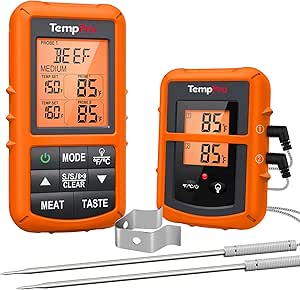
TempPro TP20 500FT Wireless Meat Thermometer with Dual Meat
Find the True Thermal Center, Not the Obvious One
The thermal center is the point in the food that is furthest from all heat sources, and it’s not always the geometric middle. For a uniformly shaped beef roast, it’s simple. But for an irregularly shaped chicken breast or leg of lamb, you have to think in three dimensions.
Before you insert the probe, pick up the food. Feel for the plumpest, thickest area. This is your target. On a large, oblong roast, you should insert a leave-in probe through the shorter side, not the long end. This ensures the probe’s tip lands in the true center of the mass, not just the center of its length. For a 7-pound pork shoulder, inserting the probe 3-4 inches into the thickest part of the muscle is key to getting an accurate reading for pulled pork.
Temp Bread, Custards, and Liquids Like a Pro
Your thermometer isn’t just for meat. For a loaf of homemade bread, an internal temperature of 190-210°F signals that the starches have set and the crumb is perfectly baked—no more gummy centers. Insert the probe diagonally through the bottom of the loaf toward the center to get a good reading without marring the top crust.
For custards like cheesecake or flan, a gentle wobble is no longer your only clue. The center should register between 150-160°F for a smooth, creamy texture without cracks or curdling. When heating oil for frying or milk for yogurt, clip the thermometer to the side of the pot. Make sure the tip is submerged but not touching the bottom surface, which can be up to 50°F hotter than the liquid itself.
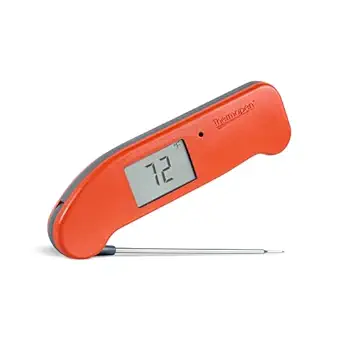
ThermoWorks Thermapen ONE, No. 1 Recommended Instant-Read
Perform a 30-Second Calibration Check Before You Cook
Perfect placement means nothing if your thermometer is lying to you. Before you even preheat the oven, perform an ice water test. It takes less than a minute.
Fill a glass completely with crushed ice, then top it off with cold water. Stir and let it sit for 60 seconds. Submerge at least two inches of the thermometer probe into the slurry, making sure not to touch the sides or bottom of the glass. After about 30 seconds, it should read exactly 32°F (0°C). If it’s off by more than 2 degrees, check your thermometer’s manual to see if it can be recalibrated. If not, it’s time for a replacement.
- Insert the probe past the dimple. The actual sensor on most thermometers is a half-inch up from the tip, not at the very point. You must insert it deep enough for the sensor itself to be in the thermal center.
- When in doubt, check two spots. For any large or irregularly shaped food, take a reading in the thickest part and then another reading in a different spot to ensure it’s cooked evenly.
- Clean your probe immediately with an alcohol wipe or hot, soapy water. Caked-on residue from a previous check can insulate the sensor, slowing down its response time and affecting accuracy.
- For leave-in probes, create a small gap for the cable. Don’t let your heavy oven door slam shut and pinch the braided steel cable, which can damage the internal wires and ruin your thermometer.
Frequently Asked Questions
Conclusion
Stop thinking of your food thermometer as a simple pass/fail device. Start seeing it as a tool for mapping temperature. The skill isn’t just knowing the target number for medium-rare; it’s knowing how to find the part of the steak that’s struggling the most to get there. The next time you cook, take 30 seconds to do the ice water test. When it’s time to temp, use the side-in method for that pork chop or visualize the path to the thermal center of your roast. This deliberate practice is the one thing that separates guessing from knowing, and it’s the key to consistently perfect results.


