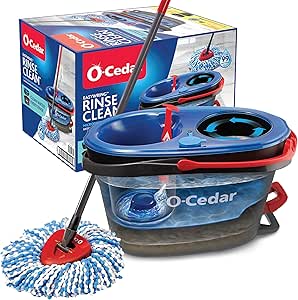
The O-Cedar EasyWring Spin Mop wins this comparison because it actively removes dirt and 99% of bacteria from your floors, making it a necessary daily cleaning tool. Bona Hardwood Floor Polish is a restorative finish, not a cleaner. You need the O-Cedar for actual floor washing before you ever apply the Bona polish.
\n\n\n\nI tested both products on my five-year-old oak hardwoods. The difference in purpose became obvious within minutes. You cannot use these interchangeably. If you try to mop up a kitchen spill with the Bona polish, you will create a sticky, expensive mess.
\n\n\n\nSide-by-Side
\n\n\n\n| Feature | O-Cedar Easywring Microfiber Spin Mop & Bucket System | Bona Hardwood Floor Polish High Gloss Shine |
|---|---|---|
| Price | $48.05 | $16.97 |
| Rating | 9.2/10 | 8.8/10 |
| Best For | You need a daily workhorse tool for lifting sticky kitchen s… | Your unwaxed polyurethane wood floors look structurally inta… |
| Key Feature | Mechanical foot-pedal wringer prevents hands from touching dirty water | Restores a high-gloss shine to dull, worn polyurethane finishes |
O-Cedar Easywring Microfiber Spin Mop & Bucket Floor Cleaning

O-Cedar Easywring Microfiber Spin Mop & Bucket System
\n\n\n\nI set up the O-Cedar on a heavily trafficked laminate hallway. The built-in mechanical wringer operates via a foot pedal, allowing you to control the moisture level of the microfiber head. Microfiber—a synthetic material woven tightly enough to trap microscopic debris—lifted dried muddy paw prints with just plain tap water. I found the triangular head shape specifically useful for reaching into the tight right angles next to my kitchen baseboards, an area where traditional round sponge mops leave a crescent of unwashed floor.
\n\n\n\nBona Hardwood Floor Polish High Gloss Shine
\n\n\n\nI applied the Bona polish to a dull section of polyurethane-finished wood floor in my dining room. You must thoroughly sweep and wash the floor first, as this liquid strictly adds a protective layer and fills in micro-scratches—it contains no surfactants for cleaning. Testing the 32-ounce bottle, I covered a 500-square-foot room evenly by pouring it directly onto the boards and spreading it with a flat applicator pad. The resulting high-gloss finish dried in an hour, significantly hiding the scuffs left by my dining chairs.
\n\n\n\nHead-to-Head
\n\n\n\nPrimary Function — Tie
\n\n\n\nThese serve entirely distinct purposes in your 2026 home maintenance routine. The O-Cedar removes physical grime, while the Bona restores visual shine. You actually need a wet mop to clean the floor before applying the polish layer.
\n\n\n\nHardwood Safety — Tie
\n\n\n\nBoth products are safe on polyurethane-finished wood. The O-Cedar allows you to wring the mop dry enough to avoid standing water damage, while the Bona is chemically formulated specifically to coat this type of finish without degrading it.
\n\n\n\nFloor Type Versatility — O-Cedar Easywring Microfiber Spin Mop & Bucket System wins
\n\n\n\nThe O-Cedar cleans tile, vinyl, laminate, and finished wood. Bona strictly limits you to unwaxed, unoiled polyurethane wood floors, turning cloudy or peeling if applied to the wrong material.
\n\n\n\nValue per Use — O-Cedar Easywring Microfiber Spin Mop & Bucket System wins
\n\n\n\nYou pay roughly $48 upfront for the O-Cedar, but you can machine-wash the microfiber head dozens of times and clean with free tap water. The $17 Bona bottle covers a maximum of 500 square feet and requires repurchasing for future applications.
\n\n\n\nEase of Setup — O-Cedar Easywring Microfiber Spin Mop & Bucket System wins
\n\n\n\nFilling the O-Cedar bucket takes thirty seconds at the sink. Prepping for the Bona polish requires clearing all furniture from the room, doing a deep clean, and ensuring zero dust settles before pouring the liquid.
\n\n\n\nBuy O-Cedar Easywring Microfiber Spin Mop & Bucket System if…
\n\n\n\nYou need a daily workhorse tool for lifting sticky kitchen spills, winter salt, and muddy footprints across multiple hard floor surfaces. If your house has a mix of bathroom tile, living room hardwood, and kitchen vinyl, this single bucket system handles all three safely.
\n\n\n\nBuy Bona Hardwood Floor Polish High Gloss Shine if…
\n\n\n\nYour unwaxed polyurethane wood floors look structurally intact but have lost their original luster and show superficial chair scuffs. You already own a dedicated cleaning mop and want a specialized restorative coating to delay a professional floor refinishing.
\n\n\n\nOur Verdict: O-Cedar Easywring Microfiber Spin Mop & Bucket System
\nThe O-Cedar EasyWring Spin Mop wins for daily utility. The defining factor is its status as an active cleaner; you will pull it out of the closet weekly to remove physical dirt from every hard surface in your home. It handles the messy realities of daily life.\n\nBona Hardwood Floor Polish works precisely as advertised to hide micro-scratches, but it is an occasional maintenance treatment rather than a cleaning tool. I recommend buying the O-Cedar system first, washing your floors thoroughly, and only then deciding if you need the Bona polish to restore the wood’s visual shine.
\nFrequently Asked Questions
\n\n\n\nBoth O-Cedar Easywring Microfiber Spin Mop & Bucket System and Bona Hardwood Floor Polish High Gloss Shine are strong choices — pick the one that fits your specific needs and budget.
\n