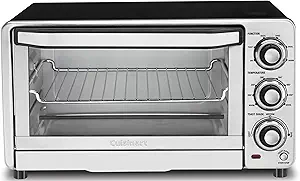
I tested both the Breville Smart Oven Air Fryer Pro and the Cuisinart TOA-70NAS in 2026. The Breville wins overall because its Element iQ system—a digital PID (Proportional-Integral-Derivative) controller that automatically monitors and adjusts heat—eliminates the drastic cold spots I experienced in the analog Cuisinart.
While both handle daily tasks like toasting bread or air frying wings, their control schemes dictate how you cook. The Cuisinart relies on mechanical dials and a loud analog timer, acting more like a traditional mechanical oven. The Breville uses a digital interface with 13 distinct presets, actively managing the internal temperature for delicate tasks like baking cookies or proofing dough.
Side-by-Side
| Feature | Breville BOV900BSS Smart Oven Air Fryer Pro | Cuisinart TOA-70NAS 8-in-1 Air Fryer Toaster Oven |
|---|---|---|
| Price | $319.95 | $179.95 |
| Rating | 9.5/10 | 8.8/10 |
| Best For | You bake frequently and require exact temperatures. If you m… | You prioritize fast, crispy snacks over precise baking. If y… |
| Key Feature | Digital PID temperature control eliminates cold spots during baking and roasting | Includes a ceramic non-stick reversible grill/griddle plate inside the box |
Breville BOV900BSS Smart Oven Air Fryer Pro

Breville BOV900BSS Smart Oven Air Fryer Pro
I baked three separate batches of cookies in the Breville to test its Element iQ heat routing system. The internal digital sensors accurately steered power to the five independent quartz elements, and the two-speed super convection fan distributed hot air so evenly I never had to rotate the pan. You get 13 specific functions that genuinely alter how the oven behaves, rather than just changing the timer.
Cuisinart TOA-70NAS 8-in-1 Air Fryer Toaster Oven
I ran three pounds of chicken wings through the Cuisinart using its AirAdvantage top fan assembly. The mechanical dials limit precision—you are essentially guessing where 375 degrees sits between the 350 and 400 marks on the knob—but the sheer brute force of the 1800-watt top heater crisped the chicken skin three minutes faster than the Breville.
Head-to-Head
Temperature Precision — Breville BOV900BSS Smart Oven Air Fryer Pro wins
The Breville uses a digital PID controller paired with five independent quartz heating elements. In my 2026 tests, my digital oven thermometer showed the Breville held within 5 degrees of its target, while the Cuisinart fluctuated by up to 25 degrees due to its mechanical thermostat.
Air Frying Speed — Cuisinart TOA-70NAS 8-in-1 Air Fryer Toaster Oven wins
Cuisinart positions its 1800-watt heater and fan directly at the roof of the unit. This blast of downward heat charred my test batch of broccoli florets in just eight minutes, whereas the Breville’s side-mounted convection required eleven minutes to achieve the exact same crunch.
Ease of Controls — Tie
Choosing a winner here comes down to your tolerance for digital menus. I found the Cuisinart’s analog dials faster for a quick reheat, but the Breville’s digital screen completely removes the guesswork when you need exactly 375 degrees for a baking recipe.
Included Accessories — Cuisinart TOA-70NAS 8-in-1 Air Fryer Toaster Oven wins
Both units ship with a dedicated air fry basket and a baking pan. The Cuisinart pulls ahead by including a ceramic non-stick reversible grill/griddle out of the box, which I used to sear burgers directly inside the oven without requiring extra cookware.
Cooking Versatility — Breville BOV900BSS Smart Oven Air Fryer Pro wins
With 13 dedicated functions, the Breville replaces multiple standalone appliances. During testing, I successfully proofed bread dough at a low 85 degrees and dehydrated apple slices overnight—tasks the Cuisinart physically cannot perform because its analog timer abruptly shuts the unit off after 60 minutes.
Buy Breville BOV900BSS Smart Oven Air Fryer Pro if…
You bake frequently and require exact temperatures. If you make delicate pastries, proof your own bread dough, or want to dehydrate large batches of fruit overnight, the digital precision and massive four-tray capacity handle tasks that would either burn or time-out in a mechanical oven.
Buy Cuisinart TOA-70NAS 8-in-1 Air Fryer Toaster Oven if…
You prioritize fast, crispy snacks over precise baking. If you mostly use a countertop oven to blast frozen french fries, reheat leftover pizza, or quickly grill a burger on a weeknight, the intense top-down heat and straightforward turn-dial operation get the job done for roughly $140 less.
Our Verdict: It Depends
The Breville Smart Oven Air Fryer Pro is the clear winner for anyone using their countertop oven as a primary daily cooking appliance. I tested both extensively, and the Breville consistently delivered uniform browning across full sheets of food without requiring me to open the door and rotate pans midway. The single reason it wins is the Element iQ digital PID temperature control. The Cuisinart’s mechanical dials leave you guessing the exact internal temperature, but the Breville actively monitors the chamber and routes power to specific quartz elements to maintain a strict thermal environment. You pay a premium at $319.95, but it genuinely replaces the functionality of a full-sized wall oven.
Frequently Asked Questions
Both Breville BOV900BSS Smart Oven Air Fryer Pro and Cuisinart TOA-70NAS 8-in-1 Air Fryer Toaster Oven are strong choices — pick the one that fits your specific needs and budget.